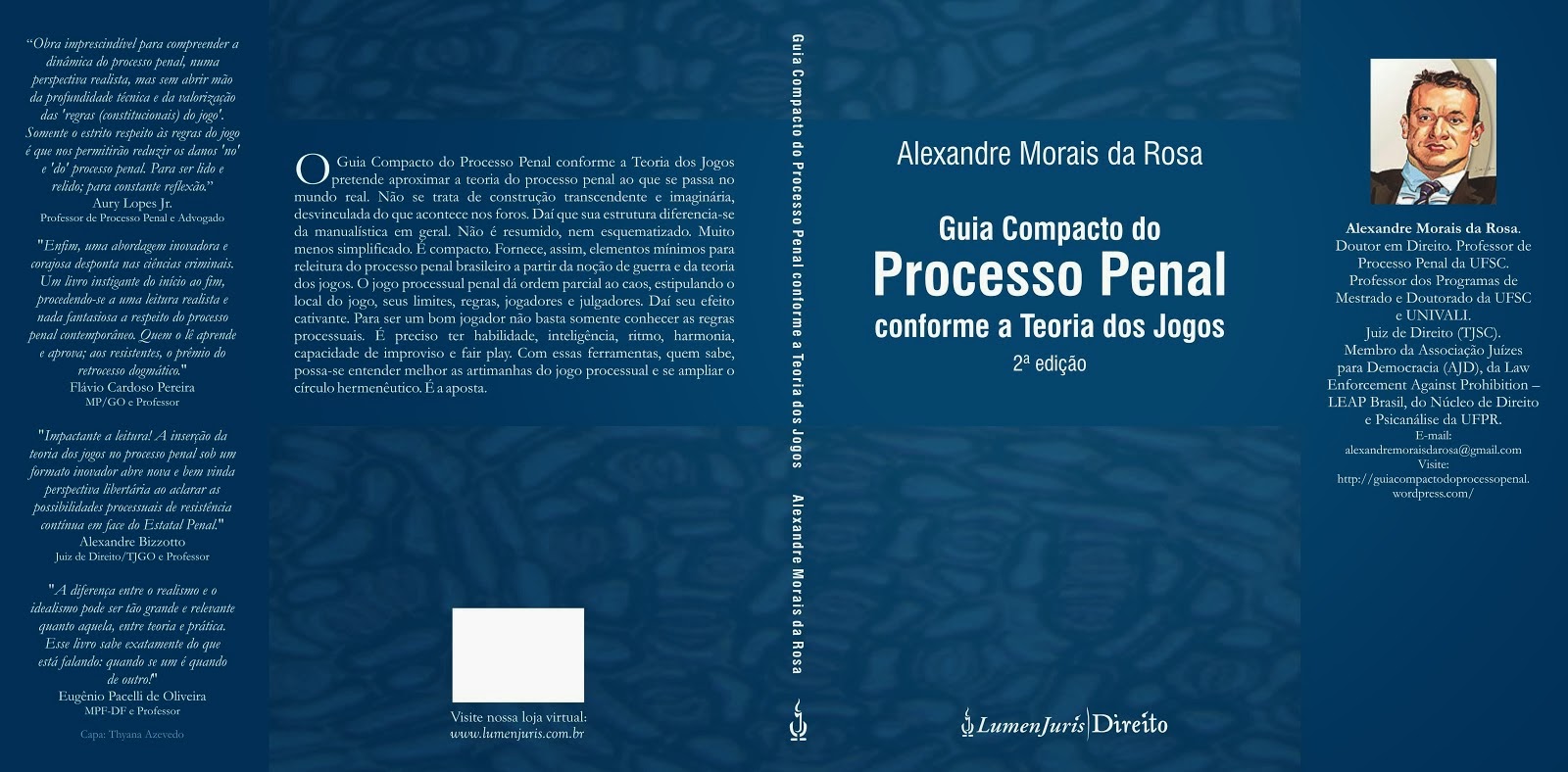
Guia Compacto do Processo Penal conforme a Teoria dos Jogos

Guia Compacto do Processo Penal conforme a Teoria dos Jogos
Alexandre Morais da Rosa

Kindle - Meu livro novo

O meu livro Jurisdição do Real x Controle Penal: Direito & Psicanálise, via Literatura foi publicado pela http://www.kindlebook.com.br/ na Amazon.
Não precisa ter o Kindle. Pode-se baixar o programa e ler o livro. CLIQUE AQUI

AGORA O LIVRO PODE SER COMPRADO NA LIVRARIA CULTURA - CLIQUE AQUI

Também pode ser comprado na LIVRARIA SARAIVA - CLIQUE AQUI

LIVROS LUMEN JURIS - CLIQUE AQUI

26/01/2011

“Operação Massacre é bom jornalismo e estímulo à Comissão da Verdade Marcelo Semer


Terra Magazine
De São Paulo

Doze pessoas são sequestradas na calada da noite pela polícia e submetidas a um fuzilamento sumário por ordem militar.
O ano é 1957 e o país é Argentina, nove meses após a chamada Revolução Libertadora, que depôs Juan Domingos Perón.
O jornalista e escritor Rodolfo Walsh inicia um percurso sem volta quando recebe, casualmente, a informação de existência de um sobrevivente deste fuzilamento.
Walsh passa, então, a usar falsa identidade, muda-se para o bairro dos acontecimentos, e provoca, a partir de suas reportagens investigativas, uma incômoda e, saberemos depois, inócua apuração judicial sobre a barbárie.
"Operação Massacre", o livro que resulta de suas reportagens, é um libelo em busca da verdade escrito como um romance policial. O livro não é apenas uma aula e tanto de jornalismo, mas também uma profissão de fé na coragem.
A mesma coragem que levou Walsh a escrever nos anos 70, uma carta aberta ao regime militar, denunciando atrocidades provocadas pela nova ditadura argentina. Este último escrito, no entanto, não virou romance nem matéria de jornal. Foi calado tal qual o autor. No dia seguinte, Walsh entrou para a longa lista de desaparecidos do regime militar que pretendeu denunciar.
Por todas as suas qualidades intrínsecas, "Operação Massacre", que antecipa o new journalism que faria o sucesso de Truman Capote ("A Sangue Frio") anos depois, deve ser lido com entusiasmo. É eletrizante como romance policial, é interessante como o making of de uma reportagem, é impactante como denúncia dos sistemas policial e judicial carcomidos pela submissão ao poder militar.
Para nós, que estamos na antevéspera da criação de uma Comissão da Verdade, seu relato é nada menos que indispensável.
O exercício do jornalista, na intrincada busca de fontes e na desconstrução minuciosa da história oficial, recheada de incongruências e obscuridades, é, em si mesmo, uma homenagem à verdade.
O detalhismo de Walsh, que chegou a buscar a grade de radialistas da noite dos fatos, para comprovar que o arrebatamento das vítimas se deu antes da lei marcial, descortinou uma a uma as ilegalidades praticadas.
A publicação das reportagens, e depois do livro, todavia, acabou servindo como única forma de reparação às vítimas esquecidas pelo Estado.
Lembrar das vítimas, lançando luz, ainda que tardiamente, às barbaridades que sofreram, é, aliás, um dos objetivos de comissões de verdade.
Por três décadas, temos convivido no Brasil com a opacidade forçada: documentos oficiais sob o manto do segredo, resistência militar ao mero conhecimento dos fatos, ausência de respostas e, em muitos casos, de reparação. Por fim, uma anistia mal interpretada impedindo julgamentos.
Mas a ocultação da realidade não legitima por si só o esquecimento.
A ideia de que é possível construir paz sem justiça, perdão sem verdade, é cada vez menos aceita entre nós. É nítida a sensação de desconforto com os cadáveres ainda insepultos da ditadura militar, que não permitem que a página dessa nossa triste história seja virada - como vem ocorrendo na Argentina.
Recente decisão da Corte Interamericana de Direitos Humanos, à qual o Brasil optou espontaneamente por reconhecer, abriu caminho inclusive para o julgamento dos atos criminosos da ditadura, com base na jurisprudência internacional que refuta anistias em crimes contra a humanidade.
A Corte recomendou expressamente que os fatos sejam apurados sob jurisdição civil, não militar. Os leitores de "Operação Massacre" bem entenderão o motivo.
A edição recentemente lançada pela Companhia das Letras agrega prefácios, posfácios, introduções e epílogos escritos por Walsh, nos quais descreve detalhadamente a construção de sua reportagem e justifica, ao longo do tempo, a mobilidade de suas opções políticas. De um apoiador da Revolução Libertadora à militância peronista e, enfim, membro ativo do movimento montonero nos anos 70.
Pode ser que o escritor de romances policiais não tenha resistido à tentação de transformar-se ele mesmo em detetive na vida real. Mas ao fazê-lo, foi afetado pelo poder transformador da verdade e as nefastas consequências das inúmeras tentativas de ocultá-la.
Como o tribunal da OEA concluiu, ao fim do processo dos desaparecidos do Araguaia, nada mais pertencente à liberdade de expressão do que o acesso à verdade. Ele é irrenunciável, inalienável e imprescritível.
Ler "Operação Massacre" nos faz entender melhor porque reconstruir a verdade sobre o passado é um requisito obrigatório para seguir adiante

Do Consultor Jurídico e do Blog do Gerivaldo - Prova ilícita e retórica...


Exame ginecológico sem autorização da justiça anula condenação de tráfico (TJSP)

Investigação que violou direitos invalida Ação Penal

Fernando Porfírio, repórter da revista Consultor Jurídico, 23.01.11

Não se pode, em um Estado democrático de Direito, admitir que a verdade processual seja alcançada por meio de violações de direitos e garantias do acusado, devendo, pois, ser ela apurada de modo ético e legal e não a qualquer custo. A concepção de que a principal finalidade do processo penal é a apuração da verdade material pode dar margem a arbitrariedades de toda magnitude.
Com esse fundamento o Tribunal de Justiça de São Paulo, num pedido de Habeas Corpus, determinou o trancamento de Ação Penal por falta de justa causa. A ação foi proposta contra uma mulher por acusação de tráfico de entorpecente. A ré foi presa em flagrante e condenada a cinco anos e dez meses de reclusão. Descontente, a defesa bateu às portas do tribunal reclamando a reforma da sentença.
O tribunal atendeu ao apelo. Concluiu que a condenação não podia sobreviver, pois foi contaminada pelo veneno da ilegalidade no seu nascedouro. E bateu o carimbo: esse processo não deveria ter ido em frente. A decisão, por votação unânime, foi da 16ª Câmara Criminal. A turma julgadora mandou expedir alvará de soltura a favor da mulher.
A ré, de 26 anos, foi presa em flagrante em 4 de fevereiro do ano passado, na fila de visitas da Cadeia Pública de Registro, município da região do Vale do Ribeira. Policiais civis teriam recebido uma denúncia anônima de que a mulher levaria entorpecentes para seu namorado, preso no local. Depois de revistá-la policiais encontraram um celular e um chip avulso escondido embaixo da bateria do aparelho.
Os policiais levaram a mulher ao posto de saúde para ser submetida a exame ginecológico. De acordo com a denúncia, o médico que a atendeu retirou da vagina da acusada 49 gramas de maconha. A droga estava embalada em plástico amarelo e envolvida em uma camisinha. A descoberta provocou a prisão em flagrante de Cristiane.
Quatro meses depois da prisão, a sentença de condenação foi proferida pelo juiz Gilberto Azevedo de Moraes Costa, da 1ª Vara Judicial de Registro. "Não há que se falar em nulidade", afirmou o juiz na sentença. "A ré, que não se envergonhou em colocar na vagina considerável quantidade de drogas, depois que foi flagrada transportando entorpecente, se diz vítima."
Para o juiz, bastava à ré não esconder a droga no local por ela escolhido para não ser submetida ao exame médico. De acordo com o juiz, a revista médica "em nenhum momento foi realizado de forma contrária ao direito". "Ademais, se a acusada ao menos tivesse se animado a espontaneamente retirar o estupefaciente de seu corpo, não teria sido realizado o aludido exame", argumentou o juiz.
No entendimento do juiz, o artigo 244 do Código de Processo Penal não prevê a concordância do suspeito ou acusado como pressuposto para a realização de busca pessoal.
"No mais, é curioso notar que, apesar dela ter dito que se sentiu constrangida pelo fato de, em ambiente reservado, ter sido examinada por um médico, sequer explicou como não sentiria a mesma sensação se tivesse entrado na cadeia e, na frente de diversos outros presos, tivesse de retirar o pacote contendo drogas de seu corpo."
Opinião oposta tiveram três de seus colegas, todos desembargadores da 16ª Câmara Criminal. Para a turma julgadora, a prisão da ré só foi determinada por conta de um exame corporal invasivo, feito contra a vontade da acusada e por determinação unicamente dos policiais, sem autorização da Justiça, o que, no entendimento dos desembargadores violou o princípio da reserva de jurisdição.
"Vê-se, assim, uma série de sucessivas e inadmissíveis violações de direitos fundamentais da paciente, tais quais os direitos à intimidade e dignidade, todos ocorridos em um só dia, e que acabaram por culminar na prisão em flagrante", resumiu o relator do recurso, desembargador Almeida de Toledo.
De acordo com Almeida Toledo basta um pouco de bom-senso para chegar à conclusão óbvia de que intervenções em partes do corpo que afetam o pudor e o recato claramente ferem a intimidade. "Evidente a incompatibilidade com a ordem constitucional dos fundamentos da determinação de que a paciente fosse submetida ao exame ginecológico, contra a sua vontade, em evidente afronta aos direitos à intimidade, à inviolabilidade de seu corpo e à sua dignidade", argumentou o relator.
A turma julgadora concluiu que diante do fato que a apreensão da droga se deu sem amparo legal não resta outra saída que não seja a do reconhecimento da ilicitude da prisão e como ela a contaminação de toda a prova produzida depois.
Depois de reconhecer como ilícitos os indícios obtidos pelos policiais civis, a turma julgadora entendeu que não sobreviveu a materialidade do delito capaz de imputar à ré qualquer prática criminosa.
Fonte: Revista Consultor Jurídico

25/01/2011

Erro de Tipo: um vídeo de graduação - impagável

ANistia - José Carlos Moreira da Silva Filho - A anistia no Brasil - ZH


Data: 20/01/2011     Fonte: Zero Hora - Internet
Imprmir

Fechar Notícia
José Carlos Moreira da Silva Filho - A anistia no Brasil
No último domingo, em Zero Hora, o escritor Percival Puggina nos brindou com um texto infeliz sobre o tema da anistia, caindo em uma série de argumentos falaciosos que, infelizmente, já viraram lugar-comum há muito tempo no nosso país. Um desses argumentos é o de que a anistia de 1979 significou a reconciliação nacional, fruto de um acordo. Em primeiro lugar, é preciso reafirmar que não houve acordo algum. O Congresso que votou a Lei de Anistia é fruto do pacote de abril de 1977, no qual Geisel, invocando o AI-5, fechou o Congresso, mudou as regras de composição da Casa, instituiu os senadores biônicos e garantiu a ampla maioria do partido que apoiava a ditadura.
O projeto enviado por Figueiredo, graças a este rearranjo legislativo, teve todas as emendas contra si barradas pelo paredão arenista. Importante lembrar que ainda se vivia uma ditadura, que existia a censura, a prisão e a tortura de presos políticos, cassações e monitoramentos. Ademais, Figueiredo já avisara que, se o projeto não passasse ou fosse modificado em sentido contrário, ele vetaria toda a lei.
O senhor Puggina afirmou que temos uma Comissão de Anistia que é contra a anistia. O que ele não disse é que a Constituição de 1988, esta, sim, a nossa norma fundante e não a Emenda Nº 26/85, quando trata da anistia só menciona o tema da reparação econômica aos perseguidos pelo Estado, não há uma linha sequer sobre a anistia a torturadores. A anistia que a Comissão de Anistia não aceita é a autoanistia imposta por uma ditadura aos seus próprios agentes.
Obviamente, a comissão não é contrária à anistia dos perseguidos políticos. Como se pode esperar a reconciliação se faltou ao Brasil dizer em alto e bom som, como o fizeram os demais países latino-americanos, que torturar é errado?
Os índices de torturas e execuções que são realizadas diuturnamente pelas forças de segurança pública são alarmantes. Os arquivos das Forças Armadas até hoje não foram abertos. Não houve sequer uma investigação ou condenação dos torturadores e dos seus mandantes. A sociedade brasileira não sabe os seus nomes. Muitos ocupam hoje cargos públicos. Um país que não conhece a sua história, que não pode aprender com os seus próprios erros não é uma democracia plena. Não é à toa que o Brasil foi condenado pela Corte de Direitos Humanos da OEA, ou será que a Corte também seria manipulada por esse grupo malévolo de esquerda ao qual o articulista se referia?

*Professor de Pós-Graduação da PUCRS e conselheiro da Comissão de Anistia do Ministério da Justiça 

Some Notes on Brazil in the Inter-American Human Rights System by Valerio de Oliveira Mazzuoli, PhD


Some Notes on Brazil in the Inter-American
Human Rights System

by
Valerio de Oliveira Mazzuoli, PhD
Juris Doctor summa cum laude in International Law by the Federal University of Rio Grande do Sul (Brazil). Post-Doctoral Researcher in International Law, University of Lisbon (Portugal). Master in International Law by the São Paulo State University (Brazil). Professor of Public International Law and Human Rights and Coordinator of the Master in Law Program at the Federal University of Mato Grosso (Brazil).

Parallel to the global system of protection of human rights, there are also regional systems of protection (e.g., the European[1] and the African[2] ones). Among them stands the Inter-American system,[3] composed of four main instruments: the Charter of the Organization of American States (1948); the American Declaration of the Rights and Duties of Man (1948), which, although not being technically a treaty, outlines the rights mentioned in the Charter of the OAS; the American Convention on Human Rights (1969), known as the Pact of San Jose of Costa Rica; and the Additional Protocol to the American Convention in the Area of Economic, Social and Cultural Rights, dubbed the Protocol of San Salvador (1988).[4]
Throughout this Inter-American set of rules, there dwells the general obligation of protecting the “fundamental rights of the individual without distinction as to race, nationality, creed or sex”[5] (Article 3, l, of the OAS Charter). In relation to the international responsibility of the American States for violation of human rights, we should highlight the system proposed by the American Convention on Human Rights, in which the Member States of the OAS take part. This system does not exclude the subsidiary application of the system introduced by the OAS Charter itself, as detailed by Article 29(b) of the American Convention (entitled Rules of Interpretation). It says that none of its provisions can be interpreted as “restricting the enjoyment or exercise of any right or freedom recognized by virtue of the laws of any State Party or by virtue of Conventions to which one of the said States may be a party”.[6]
The American human rights protection system historically originated with the proclamation of the Charter of the Organization of American States (Charter of Bogotá),[7] in 1948, adopted at the 9th Inter-American Conference, which also celebrated the Declaration of the Rights and Duties of Man.[8] The latter formed the basis of regulatory protection in the American system before the conclusion of the Convention (in 1969) and still remains the instrument of regional expression in this area, mainly to the non-parties to the American Convention.[9]
After the adoption of these two instruments, a gradual process of maturation of the mechanisms of human rights protection in the American system occurred, whose first step was the creation of a specialized body to promote and protect human rights within the OAS: the Inter-American Commission on Human Rights, a proposal adopted at the 5th Meeting of Foreign Ministers, held in Santiago, Chile in 1959. As initially proposed, the Commission should work temporarily until the establishment of an Inter-American Convention on Human Rights, which eventually took place in San Jose, Costa Rica, in 1969.
The American Convention on Human Rights,[10] which is the key instrument of the Inter-American system of human rights, was signed in 1969 and entered into force on July 18, 1978, after having obtained the minimum of 11 ratifications. Only the Member States of the Organization of American States (OAS) have the right to become part of it. Its creation has strengthened the human rights system established by the Charter of the OAS and made explicit by the American Declaration, thus making the Commission on Human Rights more effective. Until then, this Commission was only an organ of the OAS. Despite its importance in consolidating the system of individual liberty and social justice in the Americas, some countries like the United States of America, which has just signed it, and Canada have not ratified the American Convention and, apparently, are not willing to do so. Brazil did not ratify it before 1992. It was internally promulgated by the Decree 678 of November 6, in that year.
The Inter-American Court of Human Rights is the jurisdictional organ of the American system that addresses the cases of human rights violations alleged to have been committed by the States Parties of the OAS that have ratified the American Convention.[11] This is a supranational tribunal able to condemn the States Parties to the American Convention for human rights violations. The Court does not belong to the OAS, but to the American Convention, having the nature of an international judicial body. This is the second court of human rights established in regional contexts (the first was the European Court of Human Rights, based in Strasbourg, responsible for implementing the 1950 Convention[12]). Its birth was in 1978, on the entry into force of the American Convention, but its operation was effective only in 1980 when it issued its first advisory opinion, and seven years later, when it issued its first ruling.[13]
Unfortunately, the Inter-American system of human rights still lacks an effective system of enforcement of the Court judgments under the internal legislation of the States condemned, in spite of Article 68(1) of the American Convention on Human Rights (1969) which expressly provides for the commitment of States Parties in “accepting the decision of the Court in any case in which they are parties”.[14] Also Article 65, in fine, determines that the Court shall inform the General Assembly of the organization of the “cases where a State has not complied with its judgments”.[15]
The first international condemnation of Brazil for violation of rights protected under the American Convention was related to the Case of Damião Ximenes Lopes, which came from Demand 12.237, referred by the Inter-American Commission on Human Rights (which is based in Washington, in the United States) to the Inter-American Court of Human Rights (located in San Jose, Costa Rica) on October 1st, 2004. The case concerned the death of Mr. Damião Ximenes Lopes (who suffered from mental retardation) in a health center called Guararapes Nursing Home, located in Sobral, in the State of Ceará, which is part of the Brazilian Unified Health System. While in the hospital for psychiatric treatment, the victim suffered torture and ill-treatments by the attendants of the said Nursing Home. The failure to investigate and punish those responsible, and the lack of judicial guarantees, was considered to violate the Convention in four main articles: 4 (right to life), 5 (right to physical integrity), 8 (right to judicial guarantees) and 25 (right to judicial protection). In its decision of July 4, 2006 – which was the first judgment in the Inter-American system concerning human rights violations of persons with a disability – the Inter-American Court determined, among other things, the obligation of the Brazilian State to investigate those responsible for the death of the victim, to conduct training programs for professionals in psychiatric care, and to pay compensation (within one year) to the victim’s family for material and immaterial damage, totaling US$146 thousand (equivalent to R$ 280.532,85 at that time).[16]
The Brazilian government, in this case, decided to pay immediately, sponte sua, the amount ordered by the Inter-American Court, in deference to the rule of Article 68(1) of the Pact of San Jose, which provides that “States Parties to the Convention undertake to comply with the decision of the Court in any case in which they are parties”. Through the Decree 6185 of August 13, 2007, the President authorized the Special Secretariat for Human Rights of the Presidency to “promote the necessary steps to comply with the decision of the Inter-American Court of Human Rights, issued on July 4, 2006, regarding the case Damião Ximenes Lopes, especially the compensation for the violations of human rights to the family” (Article 1st).
In another case tried by the Inter-American Court (the second case against Brazil before the Court), the Brazilian State was victorious, winning an acquittal. This was the case Nogueira Carvalho vs. Brazil, submitted to the Court on January 13, 2005, by the Inter-American Commission. The demand proposed by the Commission aimed to hold the Brazilian State responsible for violating the rights provided for under Articles 8 (Judicial Guarantees) and 25 (Judicial Protection) of the American Convention, to the detriment of Jaurídice Nogueira de Carvalho and Geraldo Cruz de Carvalho, for the alleged lack of due diligence in the process of investigating the facts and punishing those responsible for the death of their son Francisco Gilson Nogueira de Carvalho, and lack of provision of an effective remedy in this case. Mr. Gilson Nogueira de Carvalho was a lawyer, a human rights activist, and devoted part of his professional work to denounce the crimes committed by the “Golden Boys” (an alleged death squad in which civil police officers and other government officials took part) and to support prosecutions initiated as a result of these crimes. On account of this he was murdered on October 20, 1996, in the city of Macaíba, in the State of Rio Grande do Norte. The Commission stressed that the poor performance of State officials, viewed as a whole, led to the lack of investigation, persecution, arrest, trial and conviction of those responsible for the murder of Mr. Gilson Nogueira de Carvalho, and that, after more than 10 years these persons had still not been identified and condemned. The Inter-American Court, in a sentence of 28 November 2006, emphasized that although it is a State duty to facilitate the necessary means to ensure that human rights defenders carry out their activities freely, as well as to protect them from threats incurred as a means to prevent injuries to their lives and integrity, there were not, in this case, elements that might prove themselves offensive to any rights provided for in the Convention. The acquittal was due to the fact that the Brazilian police opened an investigation on 20 October 1996 to elucidate the death of Gilson Nogueira de Carvalho, in which different assumptions about the authorship of the murder were considered, among them one that related his death to public denunciations filed by him against an alleged death squad known as “Golden Boys”. On this basis, the Court found that it was not established that the State violated the rights to judicial protection and guarantees enshrined in Articles 8 and 25 of the Convention.[17]
The major problem concerning the full compliance with the obligations imposed on the State by the Inter-American Court is not related to the payment of indemnity (which should be fulfilled by the State sponte sua, as did the Brazilian government in the case of Damião Ximenes Lopes, cited above), but the difficulty of performing the duties of investigating and punishing those who are responsible for violations of human rights. Although it is not expressly written in the Convention that the States have such duties (investigation and punishment of the guilty), its best interpretation is that these duties are implied there. Therefore, three obligations of the States convicted by the Court could be abstracted, when so stated in the due sentence: a) the duty to indemnify the victim or his family; b) the duty to investigate the facts in order to prevent new similar events from happening again; and c) the duty to punish those responsible for the human rights violations occurred.
Here we must emphasize that, if the State fails to observe Article 68(1) of the American Convention (which ordains that the States accept, sponte sua, the Court’s decisions), it incurs a further violation of the Convention, thus activating in the Inter-American system the possibility of a new contentious procedure against such State.[18]
Also, in case of failure by the State to comply with the sentence sponte sua, the Inter-American Court (according to Article 65 of the Convention) should so inform the General Assembly of the OAS, in the annual report to be submitted to the organization, making proper recommendations. The General Assembly of the OAS, unfortunately, has done nothing in practice to require that the States condemned by the Court comply with the reparation or compensation sentences.[19]
Unfortunately, there is no provision in Brazilian law to obligate the preferred payment of compensation ordered by the Inter-American Court. In this sense there is only the Bill 4667/2004 pending before the Congress. If approved, it will mandate the Union to pay the due compensation to the victim. Thus, pursuant to Article 1 of the Bill, the “decisions and recommendations of the international organs of human rights protection stated by treaties that have been ratified by Brazil, bring forth immediate legal effects and have binding legal force under the Brazilian legal system. It further states that “The Union, in view of the enforceable character of the decisions of the Inter-American Court of Human Rights provided for in the Legislative Decree 89 of December 3, 1998, and the quasi-jurisdictional importance of the Inter-American Commission on Human Rights provided for in the Legislative Decree 678, of November 6, 1992, will adopt all necessary measures to fully comply with the international decisions and recommendations, giving them absolute priority”. According to Article 2 of that Bill, when “the decisions and recommendations of the international human rights protection organs involve compliance with the obligation to pay, the Union will be in charge of the payment of the economic compensation to the victims”. Paragraph 1 of this Bill also requires the Union to make the payment of economic reparations to the victims within 60 (sixty) days of notification of the decision or recommendation of an international human rights protection organ.
The approval of this bill will be of fundamental importance for Brazil. Only then can the country move forward in protecting human rights and in fulfilling its international obligations.
* * *


[1]. For a study on the European system of human rights protection, see Mazzuoli, Valerio de Oliveira, O sistema regional europeu de proteção dos direitos humanos, Revista Forense, vol. 406, ano 105, Rio de Janeiro, nov./dez./2009, pp. 325-347; Fawcett, James E. S., The application of the European Convention on Human Rights, Oxford: Clarendon Press, 1987; Flauss, Jean-François, Le droit de recours individuel devant la Cour européenne des droits de l’homme: le Protocole nº 9 à la Convention Européenne des Droits de l’Homme, Annuaire Français de Droit International, vol. 36, Paris, 1990, pp. 507-519; Mahoney Paul & Prebensen, Søren, The European Court of Human Rights, The European system for the protection of human rights., R. St. J. MacDonald; F. Matscher; H. Petzold (eds.), The Hague: Martinus Nijhoff Publishing, 1993, pp. 621-643; Harris, David; Janssen-Pevtschin, Geneviève, Le Protocole nº 11 à la Convention Européenne des Droits de l’Homme, Revue Trimestrielle des Droits de l’Homme, nº 20, out./1994, pp. 483-500; O’boyle, Michael & Warbrick, Colin, Law of the European Convention on Human Rights, London: Butterworths Publishing, 1995; Gomien, Donna; Harris, David & Zwaak, Leo, Law and practice of the European Convention on Human Rights and the European Social Charter, Strasbourg: Council of Europe Publishing, 1996; Rideau, Joël, Le rôle de l’Union Européenne en matière de protection des droits de l’homme, Recueil des Cours, vol. 265 (1997), pp. 9-480; Matscher, Franz, Quarante ans d’activités de la Cour Européenne des Droits de l’Homme, Recueil des Cours, vol. 270 (1997), pp. 237-398; and Lambert, Elisabeth, Les effets des arrêts de la Cour Européenne des Droits de l’Homme: contribution à une approche pluraliste du droit européen des droits de l’homme, Bruxelles: Bruylant Publishing, 1999.
[2]. About the African regional system, see Mazzuoli, Valerio de Oliveira, Curso de direito internacional público, 5ª ed. rev., atual. e ampl., São Paulo : Revista dos Tribunais Publishing, 2011, pp. 926-938; Ngom, Benoît Saaliu, Les droits de l’homme et l’Afrique, Paris: Silex Publishing, 1984; Bello, Emmanuel G., The African Charter on Human and Peoples’ Rights: a legal analysis, Recueil des Cours, vol. 194 (1985-V), pp. 9-268; Mbaye, Kéba, Les droits de l’homme en Afrique, Paris: A. Pedone Publishing, 1992; Ouguergouz, Fatsah, La Charte Africaine des Droits de l’Hhomme et des Peuples: une approche juridique des droits de l’homme entre tradition et modernité, Paris: PUF, 1993; Umozurike, U. Oji, The African Charter on Human and Peoples’ Rights, The Hague: Martinus Nijhoff Publishing, 1997; and Evans, Malcolm & Murray, Rachel (Eds.), The African Charter on Human and Peoples’ Rights: the system in practice, 1986-2006, 2nd ed., Cambridge: Cambridge University Press, 2008.
[3]. See Ledezma, Héctor Faúndez. El sistema interamericano de protección de los derechos humanos: aspectos institucionales y procesales. San José: IIDH Publishing, 1999, 786p.
[4]. See Mazzuoli, Valerio de Oliveira. The Inter-American human rights protection system: structure, functioning and effectiveness in Brazilian law, Anuario Mexicano de Derecho Internacional, vol. XI, Mexico: UNAM Publisching, 2011, pp. 331-367; Hitters, Juan Carlos, Derecho internacional de los derechos humanos, Tomo II: Sistema Interamericano. Buenos Aires: Ediar Sociedad Anónima Publishing, 1993; Nieto Navia, Rafael, Introducción al sistema interamericano de protección a los derechos humanos, Bogotá: Temis Publishing, 1993; Dulitzky, Ariel, Una mirada al sistema interamericano de derechos humanos, América Latina Hoy, nº 20, Salamanca: Instituto de Estudios de Iberoamérica y Portugal, 1998, pp. 9-19; and Andreu-Guzmán, Federico, 30 años de la Convención Americana sobre Derechos Humanos: todavía hay mucho camino por recorrer, El sistema interamericano de protección de los derechos humanos en el umbral del siglo XXI, tomo 1., San José: Corte IDH, 2001, pp. 301-307.
[5]. For the text in Portuguese, see Mazzuoli, Valerio de Oliveira, Coletânea de direito internacional, 8ª ed., rev., ampl. e atual., São Paulo: Revista dos Tribunais Publishing, 2010, p. 261.
[6]. For the text in Portuguese, see Mazzuoli, Valerio de Oliveira, Idem, p. 1006. For a study on the interpretation of this kind of international clause, see Mazzuoli, Valerio de Oliveira, Tratados internacionais de direitos humanos e direito interno, São Paulo: Saraiva Publishing, 2010, pp. 116-128.
[7]. See Márquez, Edith. Documentos internacionales sobre los derechos humanos: la Carta de la OEA. México y las declaraciones de derechos humanos. México, D.F.: Instituto de Investigaciones Jurídicas de la UNAM, 1999, pp. 217-232.
[8]. See Buergenthal, Thomas & Cassel, Douglas. The future of the Inter-American human rights system, El futuro del sistema interamericano de protección de los derechos humanos, San José: IIDH Publishing, 1998, pp. 539-572; Ayala Corao, Carlos, El sistema interamericano de promoción y protección de los derechos humanos, México y las declaraciones de derechos humanos, México, D.F.: Instituto de Investigaciones Jurídicas de la UNAM, 1999, pp. 99-118; and Ayala Corao, Carlos, Reflexiones sobre el futuro del sistema interamericano de derechos humanos, Revista IIDH, vol. 30/31 (edición especial), San José: IIDH Publishing, 2001, pp. 91-128.
[9]. See Cançado Trindade, Antônio Augusto. Tratado de direito internacional dos direitos humanos, vol. III. Porto Alegre: Sergio Antonio Fabris Publishing, 2003, pp. 33-34.
[10]. The official Brazilian version of the American Convention on Human Rights can be found published in Mazzuoli, Valerio de Oliveira, Coletânea de direito internacional, cit., pp. 998-1015.
[11]. For details, see Dunshee de Abranches, Carlos Alberto, The Inter‑American Court of Human Rights, American University Law Review, vol. 30 (1980), pp. 79‑125; Buergenthal, Thomas, The Inter-American Court of Human Rights, American Journal of International Law, nº 76, april/1982, pp. 1-27; and Dwyer, Amy S., The Inter‑American Court of Human Rights: towards establishing an effective regional contentious jurisdiction, Boston College International and Comparative Law Review, vol. 13 (1990), pp. 127‑166.
[12]. For a detailed comparison between the two systems, see Gros Espiell, Héctor, La Convention Américaine et la Convention Européenne des Droits de l’Homme: analyse comparative, Recueil des Cours, vol. 218 (1989-VI), pp. 167-412.
[13]. See Buergenthal, Thomas. Recordando los inicios de la Corte Interamericana de Derechos Humanos, Revista IIDH, vol. 39, San José, Costa Rica: IIDH Publishing, 2004, pp. 11-31.
[14]. For the text in Portuguese, see Mazzuoli, Valerio de Oliveira, Coletânea de direito internacional, cit., p. 1013.
[15]. For the text in Portuguese, see Mazzuoli, Valerio de Oliveira, Idem, p. 1012. About this theme, see Rescia, Víctor Manuel Rodríguez, La ejecución de sentencias de la Corte, in El futuro del sistema interamericano de protección de los derechos humanos, Méndez Juan E. & Cox Francisco (coords.), San José: IIDH Publishing, 1998, pp. 449-490; and Gomes, Luiz Flávio & Mazzuoli, Valerio de Oliveira. Comentários à Convenção Americana sobre Direitos Humanos (Pacto de San Jose da Costa Rica), 2ª ed. rev., atual. e ampl. São Paulo: Revista dos Tribunais Publishing, 2009, pp. 308-310.
[16]. See Mazzuoli, Valerio de Oliveira. The Inter-American human rights protection system: structure, functioning and effectiveness in Brazilian law, cit., pp. 357-358.
[17]. See the sentence in . See also Mazzuoli, Valerio de Oliveira, The Inter-American human rights protection system: structure, functioning and effectiveness in Brazilian law, cit., pp. 358-359.

[18]. See Cançado Trindade, Antônio Augusto. O direito internacional em um mundo em transformação. Rio de Janeiro: Renovar Publishing, 2002, pp. 612-613.
[19]. For criticism of the OAS work in these cases, see Mazzuoli, Valerio de Oliveira, Comentários à Convenção Americana sobre Direitos Humanos, cit., pp. 309-310.

Mega Big Brother

Contador de visitas